AT A GLANCE
A small jewelry wardrobe works when each piece has a clear role and feels comfortable in ordinary life. Explore how to audit what you own, identify useful gaps, coordinate silver finishes, and avoid buying near-duplicates that remain unworn. This guide offers a flexible approach to choosing fewer, more usable pieces without imposing a fixed list or a single definition of minimalist style.
Start with use rather than an ideal collection
A minimalist jewelry wardrobe is sometimes presented as a list of objects everyone should own. That approach can create a surprisingly rigid shopping task. A person who never wears earrings does not need a pair merely to complete a formula. Someone who enjoys one expressive cuff may have less use for several quiet necklaces. The more useful starting point is the life the jewelry will enter: clothing, daily activities, comfort preferences, and the moments when you actually want to wear an accessory.
A small wardrobe can still contain visual variety and personal history. Minimalism need not mean pale clothing, undecorated shapes, or an absence of meaning. It can simply mean that the pieces are understandable, accessible, and useful to their owner. Begin with the objects already in your possession. Before deciding what is missing, notice which ones you reach for and what makes them easy to wear. Their practical success may tell you more than an attractive image of a complete matching set.
Audit the collection without judging its size
Place the jewelry where you can see it and group it by actual behavior. Some pieces are worn often, some are reserved for particular occasions, some need repair, and some remain unused. These groups are more informative than a simple distinction between good and bad purchases. An object kept for family meaning may be valuable to you without needing to become an everyday accessory. A frequently worn chain may deserve maintenance rather than replacement. The audit should reveal roles, not create pressure to discard.
For unworn pieces, identify the obstacle. A clasp may be difficult, a pendant too heavy, a chain too short, or a surface too assertive for your clothing. Another piece may simply no longer reflect your taste. Write down the reason before shopping. Otherwise, it is easy to buy a near-duplicate with the same unresolved problem. A clearer understanding can also reveal a small repair or adjustment that makes an existing object useful, reducing the need to add something new.
Identify the situations that recur
Think through a typical week and a few less frequent occasions. You may dress for a desk-based job, spend time outdoors, attend informal dinners, or wear a particular neckline repeatedly. Jewelry requirements can differ across these settings, and some activities are better undertaken without it. The aim is not to invent a specialized accessory for every hour. It is to identify the recurring situations in which one comfortable piece could serve several purposes without constant adjustment.
Make the description concrete. Instead of needing a work necklace, you might need a pendant that sits above a shirt fastening and does not strike the desk when you lean forward. Instead of needing elegant earrings, you might want a pair that feels comfortable for an evening and uses a familiar closure. These descriptions lead to useful specifications. They also make it easier to reject a beautiful object that answers a different question from the one your wardrobe actually presents.
Give each piece a role that can be explained
A small collection becomes coherent when you can explain why its objects differ. One necklace might provide a quiet daily line, another a more visible focal point. A cuff might be chosen for occasions when a necklace would compete with a garment. These roles can overlap, but they should not be identical by accident. If two pieces look similar and function in the same way, decide whether the difference genuinely matters to you or merely appeared significant in product photographs.
This does not require a strict rule against duplicates. Repetition can be useful when a preferred design needs a different length or when one object has a private meaning. The question is whether the second piece adds something you will use. A small wardrobe is not improved by an arbitrary count if the remaining objects do not fit. Let the roles guide the number, and allow an occasional special piece to remain special rather than demanding that every item justify itself through daily wear.
Establish a few visual connections
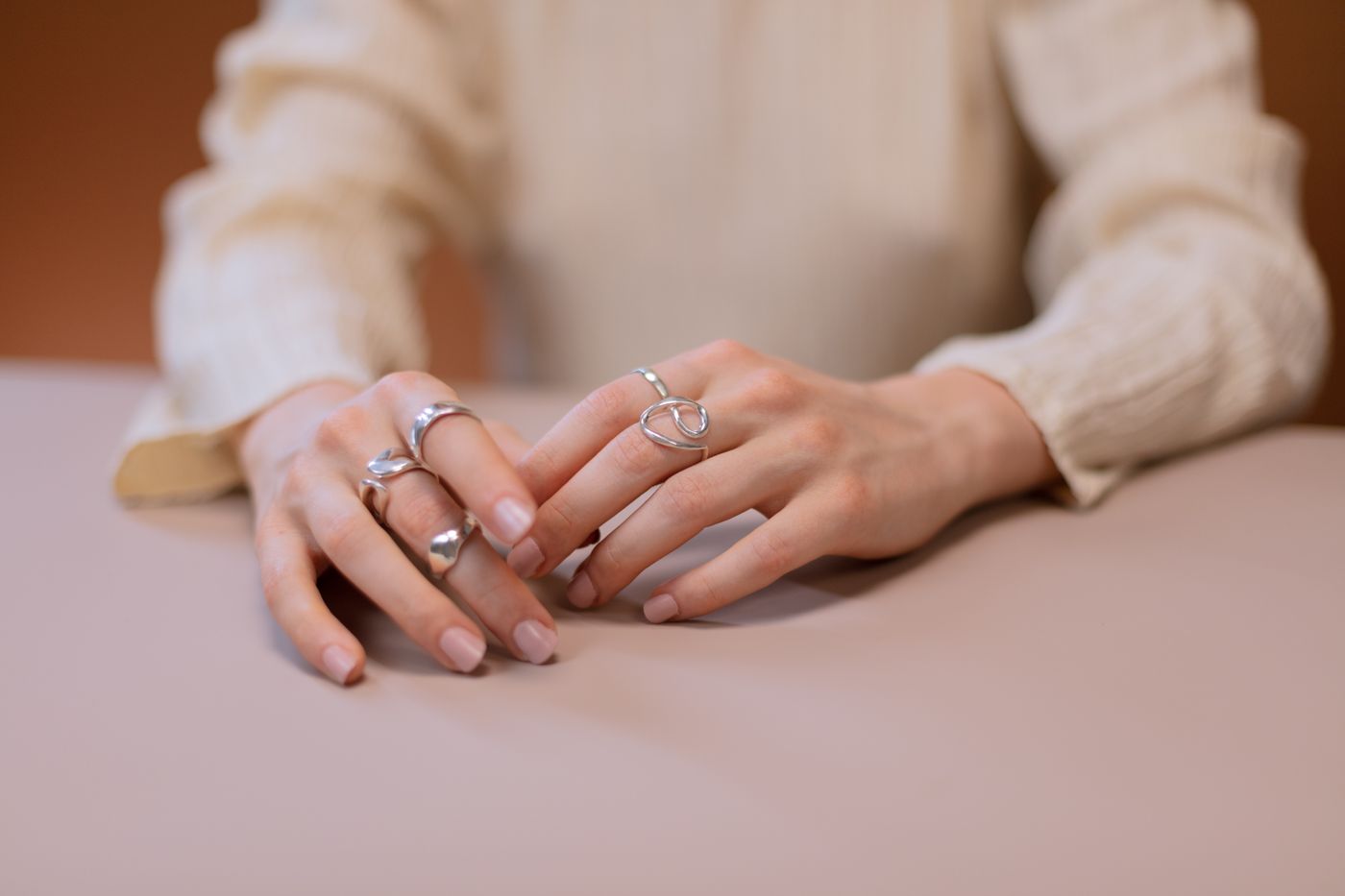
Silver can connect pieces through color while allowing differences in finish, shape, and texture. A polished chain, a brushed ring, and a textured cuff can belong to one wardrobe without matching exactly. Look for a relationship you can recognize: a rounded outline, restrained scale, or a balance of quiet and expressive surfaces. A complete matching set is one option, not a requirement. Exact uniformity may be less useful than a group of pieces that can be worn independently in different combinations.
Try the jewelry with ordinary clothing rather than arranging it only on a tray. A pair that looks harmonious side by side may compete when worn together. Conversely, different finishes can relate well across an outfit because they occupy separate areas. Evaluate the whole composition from a normal distance. A small wardrobe should make dressing easier, so avoid combinations that demand continuous monitoring to keep chains separated or prevent a bracelet from striking another piece.
Fit is a foundation, not a later correction
An object that feels wrong rarely becomes a reliable wardrobe piece through willpower. Chain length, pendant depth, ring width, bracelet opening, and closure operation can all affect use. Assess these before deciding that a design is versatile. A simple shape with an awkward fastening may be less useful than a more decorative piece that you can put on comfortably. Minimal appearance does not automatically create practical simplicity. The complete object needs to work for the wearer.
If buying remotely, compare dimensions with something you already use. A paper silhouette can help with pendant scale, while a familiar necklace can provide a length reference. These tools do not reproduce weight or movement, so keep the seller’s exchange conditions in view. Ask whether alterations are possible before assuming that every mismatch can be corrected later. Some designs have limits created by engraving, hollow forms, stones, or surface treatments. A wardrobe plan should account for those limits rather than treating adjustment as an unlimited solution.
Decide how much daily handling you want
Some people enjoy changing jewelry each morning; others prefer one reliable combination. Neither routine is inherently more thoughtful. Choose objects whose handling suits your preference. A necklace with a difficult clasp may be acceptable for rare assisted dressing and frustrating for independent daily use. Several pendants on one chain can offer flexibility, but only if changing them is straightforward and does not require repeatedly bending metal fittings. Convenience should be assessed through the full task, not the idea of interchangeability alone.
Keep the routine realistic. If you regularly remove jewelry for work or exercise, provide a stable place for it rather than hoping it will remain safe in a pocket. If you prefer to choose quickly, arrange ready-to-wear pieces separately from those needing repair. A small wardrobe becomes efficient through these ordinary decisions. The number of objects matters less than whether you can locate, fasten, wear, remove, and store them without repeated friction or confusion.
Buy for combinations you can actually test
Before adding a piece, identify the garments and jewelry with which it will be worn. If the answer remains vague, the purchase may be solving an imagined wardrobe rather than your present one. This is not a prohibition on experimentation. It is a way to distinguish a deliberate new direction from an object bought because the product page supplied an attractive complete scene. You can choose novelty more confidently when you understand what else it requires.
Try a possible combination using what you already own. A different chain length or a quieter companion piece may create the effect you wanted without a new purchase. If something is genuinely missing, describe the gap in functional and visual terms. A pendant that provides a clear focal point over a plain high neckline is a more useful target than another beautiful silver necklace. Specificity helps you compare designs without allowing each new photograph to redefine the entire task.
Leave room for a meaningful exception
A family pendant, an unusual commission, or a gift may not coordinate with every outfit. It can still belong in a small collection. Its role may be personal rather than broadly versatile. The important distinction is between recognizing that role and forcing the object into daily use because every possession is expected to meet a productivity test. A jewelry wardrobe can contain memory as well as function. Keeping a special piece safely does not make the rest of the collection less coherent.
If you want to wear the object more often, explore a practical adjustment without erasing its character. Another compatible chain or a more suitable closure may help. If alteration would change a feature you value, occasional use may be the better choice. There is no universal requirement to modernize an heirloom. A small wardrobe becomes more personal when it accommodates the owner’s attachments rather than treating every difference as clutter that must be corrected.
Consider care capacity before adding materials
A simple all-silver piece and a mixed-material pendant may require different routines. Stones, wood, lacquer, cord, coatings, and deliberate finishes can introduce care limits. If you want a very straightforward wardrobe, choose objects whose instructions you can comfortably follow. That does not mean avoiding every interesting material. It means understanding what each addition asks of you before buying it, rather than discovering later that the maintenance routine is incompatible with your habits.
Save care information in a form you can find. A concise note linked to a photograph is often enough. Keep products and cloths identified so that an object is not treated with whatever happens to be nearest. If a piece repeatedly needs attention, consider whether the storage or wearing arrangement contributes to the issue. A small collection should support attentive ownership, but it should not become a project whose complexity outweighs the pleasure of wearing the jewelry.
Distinguish a useful upgrade from a repeated purchase
An upgrade should solve a defined problem or provide a feature you genuinely value. Replacing a chain because the clasp is unusable may be reasonable, though a repair could also be explored. Buying a nearly identical pendant because its listing uses more elevated language may not change your experience. Compare specifications, construction, fit, and service rather than assuming that a higher price or a more polished presentation necessarily delivers a more useful object.
Do not justify a wardrobe purchase through promises of future financial return. This guide concerns use and aesthetic preference, not investment performance. Decide what you can comfortably spend and what benefit the new piece provides in your routine. A modest object with clear materials and good support can be a sound wardrobe choice. If the advantage remains difficult to explain without repeating a seller’s slogan, take more time before adding another item with the same practical role.
Maintain a pause between interest and purchase
When a design catches your attention, save its details and revisit them after the immediate impression has settled. Check whether the dimensions, finish, and closure still suit the role you identified. Read the return conditions and clarify unanswered material questions. This pause is especially helpful when photography creates a strong mood that may not reflect the object’s scale or everyday appearance. You can remain interested while asking for the information needed to make a practical decision.
If the piece is limited or a commission requires a decision, the same questions still matter. Scarcity does not resolve fit, construction, or care. A clear description of why you want the object can help you decide without turning urgency into the main reason. A small wardrobe is built over time, and an unfilled gap is often easier to live with than a rushed purchase that adds cost while leaving the original need unanswered.
Review the wardrobe through wear, not display
After using a new piece, notice what role it actually takes. It may become more versatile than expected or reveal a limitation. Update the plan accordingly rather than forcing the object to fit your original idea. A collection can evolve with work, clothing, comfort, and personal preference. The point is not to preserve a perfect initial list. It is to maintain a group of objects that remains intelligible and useful as the wearer’s life changes.
Return to the audit occasionally, especially when several pieces have stopped being worn. Separate repairs from preference changes and sentimental storage from daily use. You may discover that the wardrobe needs no new jewelry, only clearer organization or a small adjustment. That is a useful result. Minimalism becomes practical when it reduces unnecessary decisions, not when it creates an endless search for the final perfect object that will make every other choice irrelevant.
Let simplicity emerge from coherence
A satisfying small silver wardrobe does not need to meet a universal number or visual formula. It needs pieces that fit, roles that make sense, and a routine that supports their use. Some objects can be quiet and adaptable; another can be expressive or personally significant. Their connection comes from the wearer’s choices and the clarity of their function, not from every surface being identical or every item belonging to the same branded set.
Choose deliberately, keep useful information, and allow actual wear to guide the next decision. The result may grow slowly and include fewer purchases than a catalog checklist suggests. That is not a limitation if the objects you have remain comfortable and meaningful. A small wardrobe works when it gives you a few reliable ways to dress as yourself, leaving the jewelry available for enjoyment rather than turning it into another complicated system to complete.
For general education. The identity, treatments, construction, and condition of an individual object may require professional examination. Our editorial approach.
Back to the beginning