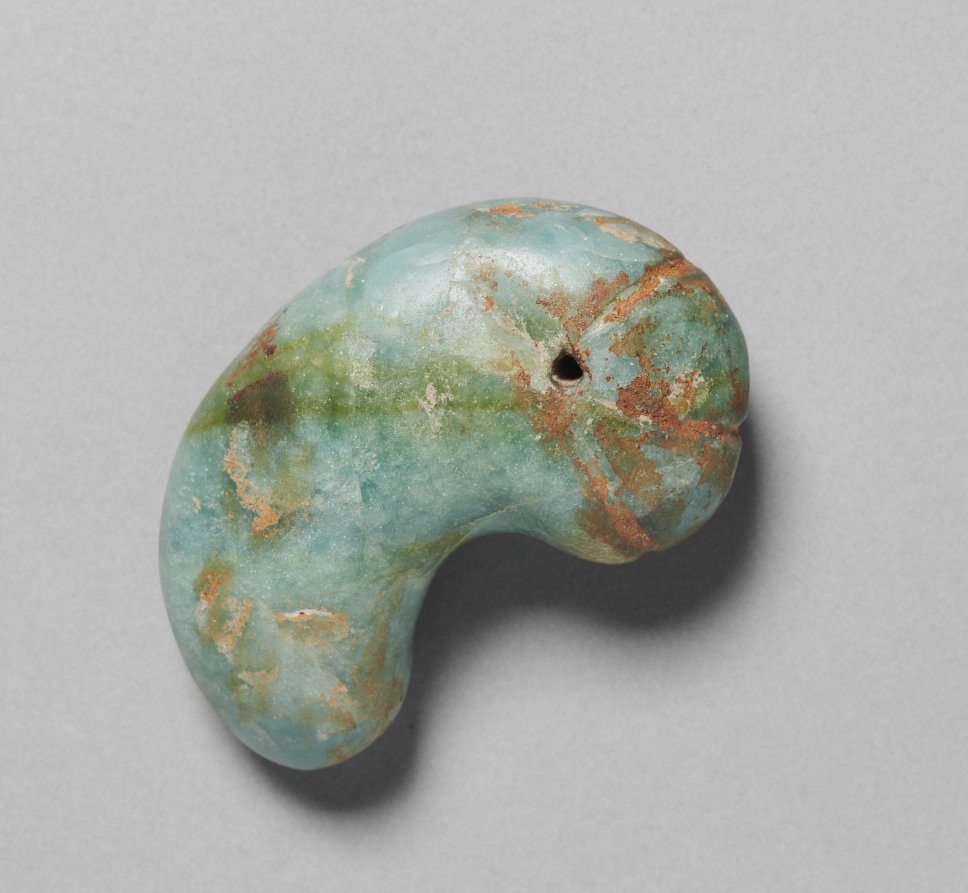
AT A GLANCE
A jade pendant is a small composition of stone, suspension, chain or cord, and the clothes around it. This guide considers scale, thickness, balance, carved openings, metal fittings, and practical care. It offers a way to compare individual pieces thoughtfully, with attention to the reverse and the hanging mechanism as well as the color and carving that first attract the eye.
Think of the pendant as a complete object
A pendant is often introduced by its most attractive surface: a polished stone, a carved motif, or a particularly pleasing distribution of color. Once worn, however, it operates as a small system. Stone, hole or bail, connecting ring, chain or cord, and clasp all work together. A compelling front view cannot compensate for an awkward suspension or a chain that does not move comfortably. Begin by considering the entire object rather than treating the stone as an isolated image.
The intended use provides a useful starting point. A pendant worn over knitwear may need a different scale from one worn against the skin inside an open collar. A piece chosen for occasional evening wear can be evaluated differently from one expected to accompany commuting and office work. Define that use before comparing options. It makes questions about dimensions, length, and construction concrete, and reduces the temptation to choose solely because a close-up photograph looks impressive.
Translate dimensions into a real scale
Product photographs often fill the frame with a pendant that is much smaller in life than the image suggests. Ask for height, width, thickness, and weight of the actual piece. Clarify whether the quoted height includes the bail. A stone measurement and an overall pendant measurement are not interchangeable. An illustrated outline on paper can help you picture the dimensions beside a familiar necklace, although it will not reproduce the feel of the weight.
Avoid treating a model photograph as a precise measuring tool. The model's body, camera angle, crop, and chain length influence the apparent scale. A simple photograph beside a ruler is less atmospheric but often more useful. If buying remotely, compare the stated measurements with an object you can hold. The exercise is not about finding a universally correct size. It is about discovering whether the pendant's actual presence matches the role you want it to play.
Thickness influences presence and balance
Two pendants with similar outlines may behave differently because their thickness and weight differ. A thicker piece can feel more substantial and sit differently against clothing. A thin carving may allow light to pass through selected areas more readily, which changes its photographed appearance. Neither property automatically establishes better quality. Ask whether the thickness is fairly even or whether carved recesses create much thinner areas that deserve special care.
Look at side views as well as the front. They reveal how the pendant projects from the body, whether metal fittings stand proud of the stone, and whether the suspension is positioned centrally. A pendant that is visually delicate from the front may be surprisingly deep at the back. These observations are particularly useful when the piece will be worn under a collar or with a short chain, where contact and projection are more noticeable.
Examine the suspension point
The suspension deserves a close photograph. Some jade pendants are drilled directly; others use a metal bail or an additional connecting element. Ask how the chain or cord passes through, whether the fitting is fixed or articulated, and whether the aperture accommodates the necklace you intend to use. A generous-looking bail can still have a narrow internal space, particularly if the chain's end fitting must pass through it.
Do not force a clasp or chain end through an opening that is too small. Repeated pressure can abrade cord, distort a fitting, or place stress on the pendant. A jeweler may be able to suggest a compatible connection, but modifications should be discussed before purchase if the return depends on keeping the item unchanged. Practical compatibility is not a minor finishing detail. It determines whether the pendant can be worn securely in the way its owner expects.
Look at drilled holes and carved openings
A hole in stone should be considered part of the construction rather than merely an invisible route for the cord. Request photographs of both ends where possible. Look for the amount of stone surrounding the opening, the way the edges are finished, and any disclosed damage nearby. A photograph cannot certify structural condition, but it can help identify areas that need explanation or professional examination before a significant purchase.
Openwork carving introduces a different kind of detail. Fine bridges and narrow projections can be visually beautiful while needing thoughtful handling. Ask how the pendant should be stored and whether particular areas are vulnerable to snagging. Avoid testing them by flexing or pushing. The goal is to understand the design's practical requirements, not to prove strength through an improvised challenge. A substantial, simple silhouette may suit daily wear better than an intricate piece if your routine involves frequent contact with hard surfaces.
The reverse is part of the design
Many listings provide several variations of the front and very little information about the back. Request a clear reverse view. The underside may be smoothly rounded, flatter, carved, recessed, or fitted with metal elements. Each can change how the pendant feels against the skin and how it lies on clothing. Check whether the seller has described any inscriptions, repairs, adhesive, or signs of previous mounting visible from behind.
The reverse can also affect movement. A pendant with a rounded back may turn or settle differently from one with a flatter contact area. Neither behavior is automatically undesirable; some people enjoy movement, while others want the front to remain consistently visible. If turning would bother you, ask to see a short wearing demonstration rather than assuming that an attractive still photograph predicts stable orientation. A complete description includes the surfaces that ordinary ownership will expose.
Choose chain length around clothing
Chain length changes where a pendant meets the body, but a measurement alone cannot predict every neckline. Try a similar length with the shirts, dresses, and knitwear you wear most. Notice whether the pendant falls into a neckline opening, rests on an edge, or competes with buttons. A position that looks elegant with one garment may become visually awkward when it lands exactly on the border of another.
Consider adjustability if you want one pendant to serve several outfits. An extension can be useful, provided the overall construction remains appropriate to the pendant's weight and the clasp is manageable. Do not assume that a very fine chain is suitable simply because it fits through the bail. Ask a jeweler about the chain and connector as a complete arrangement. The right length and the right construction are separate requirements, and both deserve attention.
Cord offers a different visual language
A cord can emphasize the pendant's carved or sculptural character, whereas a metal chain may introduce a brighter rhythm. The choice is stylistic as well as practical. Cord thickness, color, knot placement, and adjustability all influence the result. A dark cord can frame pale stone clearly; a softer tonal relationship can make the pendant feel quieter. These are visual possibilities, not rules about a stone's supposed energy or the wearer's identity.
Ask how the cord should be maintained and replaced. Inspect areas that rub against holes or fittings and avoid continuing to wear a visibly worn connection. A decorative knot is not automatically a secure fastening, and an adjustable arrangement should move predictably without slipping during ordinary use. If replacement is likely to be needed, preserve the dimensions and construction details. That makes later maintenance easier than trying to recreate a complicated arrangement from a front-facing photograph alone.
Read carving through form rather than density
An elaborate motif is not automatically a better carving than a restrained shape. Look at the relationship between the design and the material: how the outline uses color, whether surfaces are coherent, and whether the carving remains legible at normal viewing distance. Close-up photography can reward fine detail that disappears when the pendant is worn. A simpler form may communicate more clearly in the context of an everyday wardrobe.
Ask about motif names without assuming that a seller's interpretation is universal. Symbolic meanings can vary across regions, periods, families, and individual use. If a design has religious associations, approach it with curiosity and respect rather than treating it as a guaranteed mechanism for luck, protection, or health. You can choose a pendant for personal meaning while distinguishing that meaning from a factual promise about what the object will do.
Evaluate color in more than one setting
The color you enjoy in a close-up may interact differently with clothing. Pale jade can blend with a cream shirt, dark jade can recede against a black sweater, and a strong green accent can become the focus of a neutral outfit. Ask for images against a plain background and, if available, in ordinary diffuse light. A highly backlit image may be useful for observing the distribution of light, but it should not be your only view.
Be cautious about naming a narrow screen color as an exact requirement. Displays, lighting, exposure, and the stone's own thickness all influence what you see. If precise matching matters, an in-person examination or a clear return arrangement is more useful than repeated assurances about a color adjective. The pendant need not match every other accessory exactly. Sometimes a deliberate difference in tone creates a calmer composition than an unsuccessful attempt to make several natural materials look identical.
Plan for metal and stone together
Where a pendant includes metal, ask for the metal description and whether there is plating or another surface finish. The fitting may require different care from the stone. A cleaning product chosen to brighten metal can be unsuitable for adjacent materials, while a method suitable for a plain stone may affect adhesive or a decorative finish. Keep the completed construction in mind whenever you receive a broad cleaning recommendation.
If you are sensitive to particular metals, request a sufficiently specific composition statement rather than relying on a color description or a vague luxury term. This guide cannot determine individual skin compatibility. A person with known sensitivities may need advice from an appropriate professional and should avoid treating a seller's general claim as medical assurance. A beautiful pendant should be evaluated for practical suitability as well as visual appeal, especially when its fitting rests directly on the skin.
Keep technical claims separate from design preference
Enjoying a pendant's appearance does not establish its material identity, treatment status, geographical origin, or age. Those claims need their own support. Ask for a clear material description and treatment disclosure; where a laboratory report is supplied, make sure it relates to the actual item. Conversely, a report describing the stone does not tell you whether the bail is comfortable, the chain is suitable, or the design works with your clothes.
For an older or previously owned pendant, ask about condition and modifications. A replacement bail, repaired opening, or later mounting may be entirely compatible with your intended use, but it should be understood. Keep uncertainty visible instead of turning an appealing narrative into established history. A reliable purchasing file can include the seller's stated information, independent documentation, and questions that remain unanswered. It does not need an invented story to justify personal enjoyment of the object.
Make the final comparison practical
Before choosing, compare two or three candidates using the same headings: overall dimensions, weight, suspension, compatible chain or cord, reverse shape, condition, material disclosure, documentation, care, and return terms. This small exercise often reveals that an apparently minor fitting detail will matter more in daily life than a dramatic difference in a close-up. Leave space for aesthetic preference, but give it accurate practical information to work with.
Once the pendant arrives, inspect it gently in good light and test the necklace arrangement over a soft surface. Preserve the packaging and keep the item unchanged while deciding whether it matches its description and your needs. Store it so that hard objects cannot rub against it and periodically check the connection before wear. The most satisfying pendant is not necessarily the largest, brightest, or most ornate. It is the one whose form, construction, and meaning remain comfortable companions in ordinary use.
A small wearing trial
If you can try a pendant before buying, spend a few quiet moments observing its movement. Sit, stand, lean slightly forward, and look at how it settles when you return to a normal posture. Notice whether the chain twists, the pendant turns, or the bail presses awkwardly against the stone. These observations are about compatibility with your routine, not a test that every pendant must pass in exactly the same way.
Bring a familiar necklace if you want a useful comparison, and ask before attaching a personal chain to a shop item. Sometimes the difference you notice comes from the necklace length rather than the pendant itself. Trying one controlled change at a time helps clarify that distinction. A considered trial makes the eventual choice easier to explain: you are choosing a particular balance of scale, movement, comfort, and visual presence, rather than an attractive photograph alone.
References & further reading
References provide background and further reading. Linked organizations do not endorse or certify this publication.
For general education. The identity, treatments, construction, and condition of an individual object may require professional examination. Our editorial approach.
Back to the beginning