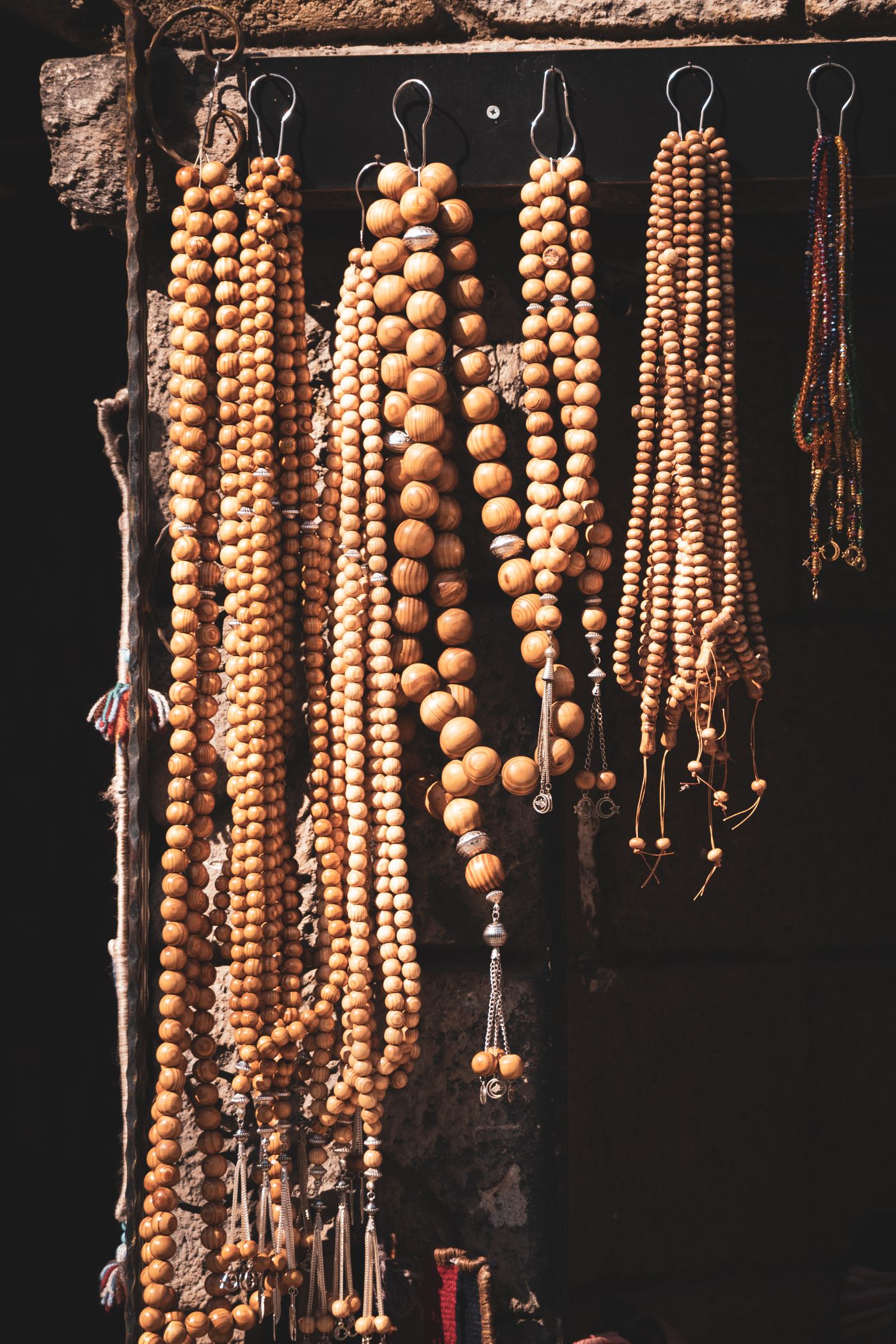
AT A GLANCE
A string of beads may be an accessory, a devotional object, a family possession, or several things at once. This guide offers a respectful way to ask about Buddhist prayer beads and related designs without inventing universal rules. Explore terminology, materials, symbols, purchasing questions, gifting, photography, and the difference between personal meaning and unsupported spiritual or health promises.
Recognize that similar forms can have different purposes
A circle or strand of beads is a simple form with many uses. It can be worn as decoration, used for counting, carried as a devotional object, preserved as a family possession, or made for a particular community. Similar appearance does not establish identical meaning. When a bracelet is described as prayer beads, ask what tradition or use the description refers to. The answer may concern the original design, the maker's intention, or a later owner's practice. Keeping those possibilities separate is the first step toward understanding the object without reducing it to an aesthetic label.
For someone interested mainly in wooden accessories, this does not require adopting a belief system. It does require recognizing that a form you enjoy visually may have a more specific role for another person. Curiosity can remain modest: learn the name used in the relevant context, identify any clearly described symbols, and avoid claiming expertise after reading a short product description. A respectful approach leaves room for living practitioners to explain their own customs and for objects to carry more than one kind of significance. It does not insist that every bracelet has a single hidden meaning waiting to be decoded.
Use terminology with attention to context
Terms associated with prayer beads come from different languages and communities. Retail descriptions sometimes use several of them interchangeably to improve search visibility, even when the object has no clearly stated connection to a particular practice. If a precise term matters, ask the maker or a knowledgeable practitioner how it applies. Museum collection records can provide useful examples of objects identified within a specific historical or regional context, but one example should not become a rule for all contemporary users. The useful habit is to preserve the context attached to a term rather than treating vocabulary as decoration.
In your own description, plain language is often safest. Wooden bead bracelet may accurately describe an accessory whose devotional origin is unknown. Buddhist prayer beads may be appropriate when the object is documented or explicitly made for that purpose. If you do not know whether a particular name applies, say so. You do not lose appreciation by avoiding a more impressive label. Accurate terminology supports both cultural respect and practical communication, especially when you later ask about repair, gift the object, or discuss it with someone whose experience is more specific than your own.
Avoid turning one community's practice into a universal rule
Bead counts, materials, arrangements, gestures, and handling customs can differ among traditions and communities. A rule found in one source should not be presented as binding on every Buddhist or every bead wearer. Even a knowledgeable practitioner may be describing the practice they were taught rather than a global standard. When you encounter advice about how beads must be worn, ask where that advice comes from and whom it is intended to guide. This question is particularly useful when a commercial seller presents a very specific claim without naming any community or source.
If you are participating in a religious setting, follow the guidance of the people responsible for that setting. Ask politely before using, moving, photographing, or wearing an object that belongs to a temple or another person. A general article cannot replace local instructions. If you are choosing a secular bracelet, there is no need to invent a ritual to make the purchase feel meaningful. You can appreciate material and workmanship while acknowledging a design reference. Respect is expressed through accurate description, appropriate behavior, and openness to correction, rather than through memorizing a collection of unsupported internet prohibitions.
Understand materials without ranking spiritual worth
Prayer beads have been made in varied materials, and museum collections include examples combining organic and mineral components. Material can relate to availability, craft, tradition, symbolism, personal preference, or the history of a particular object. A wooden strand is not automatically more spiritually serious than one made from another material. Nor does an expensive wood establish the sincerity or status of its owner. Be cautious of sales narratives that transform price into a measure of devotion or imply that only a rare material can support a meaningful practice.
When buying an accessory, evaluate the material description, construction, fit, and sourcing in ordinary terms. If you are buying for an actual devotional use, ask someone knowledgeable in the relevant community which practical features matter. The answer may concern the arrangement or handling rather than luxury. Avoid presenting a material's fragrance, grain, or tactile quality as evidence that it produces health benefits or supernatural protection. A person may find an object meaningful or pleasant to hold without making a scientific claim. That distinction allows personal experience to remain personal and prevents cultural language from becoming a vehicle for misleading promises.
Read symbols before choosing them as decoration
A carved image, written character, mantra, or emblem can introduce meaning beyond the plain bead form. Before choosing a prominent motif, learn what it represents in the seller's stated context and whether the translation is reliable. Do not assume that an unfamiliar inscription is simply an abstract pattern. Ask for the original wording and a clear explanation if text is involved. If the seller cannot identify the symbol accurately, consider a design without it rather than wearing a claim you do not understand. A minimal accessory does not need an inscription to feel considered.
You can also distinguish appreciation from a claim of affiliation. Wearing a motif does not necessarily make you a representative of the associated tradition, but others may reasonably ask about it. A straightforward explanation of why you chose the piece is more respectful than inventing a spiritual biography around it. If you discover that a design carries a significance you are uncomfortable using casually, choose another object or change how you wear it. Learning can alter preferences without requiring defensiveness. The aim is not to achieve flawless cultural knowledge before dressing; it is to respond thoughtfully to information as it becomes available.
Choose sellers who explain rather than mystify
A useful product description identifies materials, dimensions, construction, and the basis for cultural claims. It may name a tradition or design influence without pretending that the bracelet has been universally authorized. If a seller says an object was made or blessed in a particular setting, ask what that statement means and whether it refers to the specific piece. Do not assume that a photograph of a religious building establishes the origin of every item in a shop. Images can create an association that the written description never actually supports.
Be cautious when a seller uses fear or urgency: promises that a bracelet prevents misfortune, claims that removing it will cause harm, or assertions that a more expensive version has stronger protective power are not useful grounds for purchasing jewelry. Cultural meaning does not excuse misleading claims. You can select an attractive, honestly described object without accepting a system of threats or guaranteed outcomes. A transparent seller should be comfortable with practical questions and should not imply that asking about sourcing, returns, or construction demonstrates disrespect. Ordinary consumer clarity and cultural sensitivity can support each other.
Make room for a secular relationship with beads
Some people like the repeating form of wooden beads, the feel of a smooth surface, or the restrained palette of a simple strand. Those preferences can be described directly. You do not need to claim that the accessory changes your energy, improves a medical condition, or unlocks a tradition in order to justify enjoying it. A secular design can also be informed by craft history without presenting itself as a ritual object. The distinction becomes especially clear when a maker uses a plain arrangement and explains the material rather than attaching dramatic promises.
If you use a bracelet as a personal reminder to pause or return attention to an ordinary task, describe that as your chosen habit. The object does not have to possess an independently proven power for the habit to be meaningful to you. Avoid generalizing your experience into advice that everyone should expect the same effect. Likewise, do not replace professional care or other practical support with jewelry. A bracelet can accompany a person's life while remaining an accessory. This modest framing protects both the integrity of cultural references and the clarity of information offered to other people.
Give religiously associated objects with care
A gift can unintentionally assign beliefs or obligations to its recipient. Before giving prayer beads, consider whether the person actually wants a devotional object, appreciates the relevant design, or would prefer a plain bracelet. If you are unsure, ask or select something with fewer implied meanings. Do not frame the gift as a cure, a guarantee of protection, or a requirement to follow a ritual. A thoughtful note can explain the craftsmanship and the reason you associated the design with the recipient without claiming to know what spiritual role it should have in their life.
For someone who practices within a particular tradition, ask about appropriate features rather than assuming that the most ornate or expensive strand is the best choice. Fit, arrangement, and intended use may matter more than rarity. Include accurate material information and any care instructions, especially for wood or mixed components. If the object has a documented prior owner or a specific origin, preserve that information. If it does not, avoid inventing a story to make the gift feel special. Attention to the recipient and honesty about the object provide enough substance for a meaningful presentation.
Handle photography and display thoughtfully
Photographing your own bracelet for a personal record is different from photographing religious objects in a shared or sacred setting. Follow site rules and ask permission when people, ceremonies, or objects belonging to others are involved. Do not rearrange a temple object to improve a product-style photograph. Context matters to both the people present and the meaning of the image. A beautiful photograph obtained through inappropriate handling does not become respectful because the caption uses appreciative language. When permission is uncertain, keep the camera away and ask a responsible person first.
For a secular jewelry website or personal display, avoid staging that implies endorsement by a religious community or a connection that does not exist. A bracelet placed beside a sacred image can suggest a story beyond the facts. Simple neutral photography often communicates the material and design more accurately. If an object is genuinely associated with a known collection or practice, describe the connection precisely and respect applicable image rights. You can create an elegant visual presentation without using cultural objects as anonymous scenery or treating living traditions as a general luxury mood.
Repair and preserve meaning through conversation
For an ordinary fashion bracelet, changing the cord or bead sequence may be a straightforward design decision. For a devotional or inherited object, the arrangement may carry significance to its owner. Before authorizing repair, photograph the complete strand, count components, and note their positions. Tell the repairer which features you want preserved and which changes are acceptable. If you follow a particular practice and have questions about alterations, consult an appropriate person within that community. A general repair service should not be expected to determine religious requirements on your behalf.
Keep any removed original components when they matter to you, and record the work performed. A replacement cord does not automatically erase meaning, but the owner should have the chance to decide how the object is treated. When passing it on, explain both the known practical history and any personal association without presenting your interpretation as universal. This is particularly helpful for family objects whose use has changed over time. An honest record can acknowledge that one person used the strand devotionally while another preserved it primarily as a reminder of that person.
Let respect remain an ongoing practice
There is no short checklist that turns every possible use of prayer beads into a universally approved choice. Communities differ, objects differ, and the context of wearing or displaying them matters. A more useful approach is to remain specific: identify what you know, avoid claims you cannot support, ask when entering a particular setting, and listen when someone explains a relevant custom. You can appreciate a wooden bracelet while admitting that you are still learning about its design references. Modesty of knowledge is more constructive than a confident but inaccurate explanation delivered to every person who notices the object.
Personal style can make room for cultural depth without consuming it as a sales device. Choose well-made objects with clear descriptions, learn the meaning of prominent symbols, and separate aesthetic enjoyment from devotional use and health claims. If your understanding changes, let your choices change with it. The resulting relationship with jewelry may be quieter, but it is also more grounded. A strand of beads can remain beautiful as a crafted object, meaningful as a personal possession, or important within a living tradition, without requiring those different roles to be collapsed into a single story.
References & further reading
- Nara National Museum: Rosary, quartz and wood
- Nichiren Shu: Juzu
- Penn Museum: Prayer beads collection record
References provide background and further reading. Linked organizations do not endorse or certify this publication.
For general education. The identity, treatments, construction, and condition of an individual object may require professional examination. Our editorial approach.
Back to the beginning