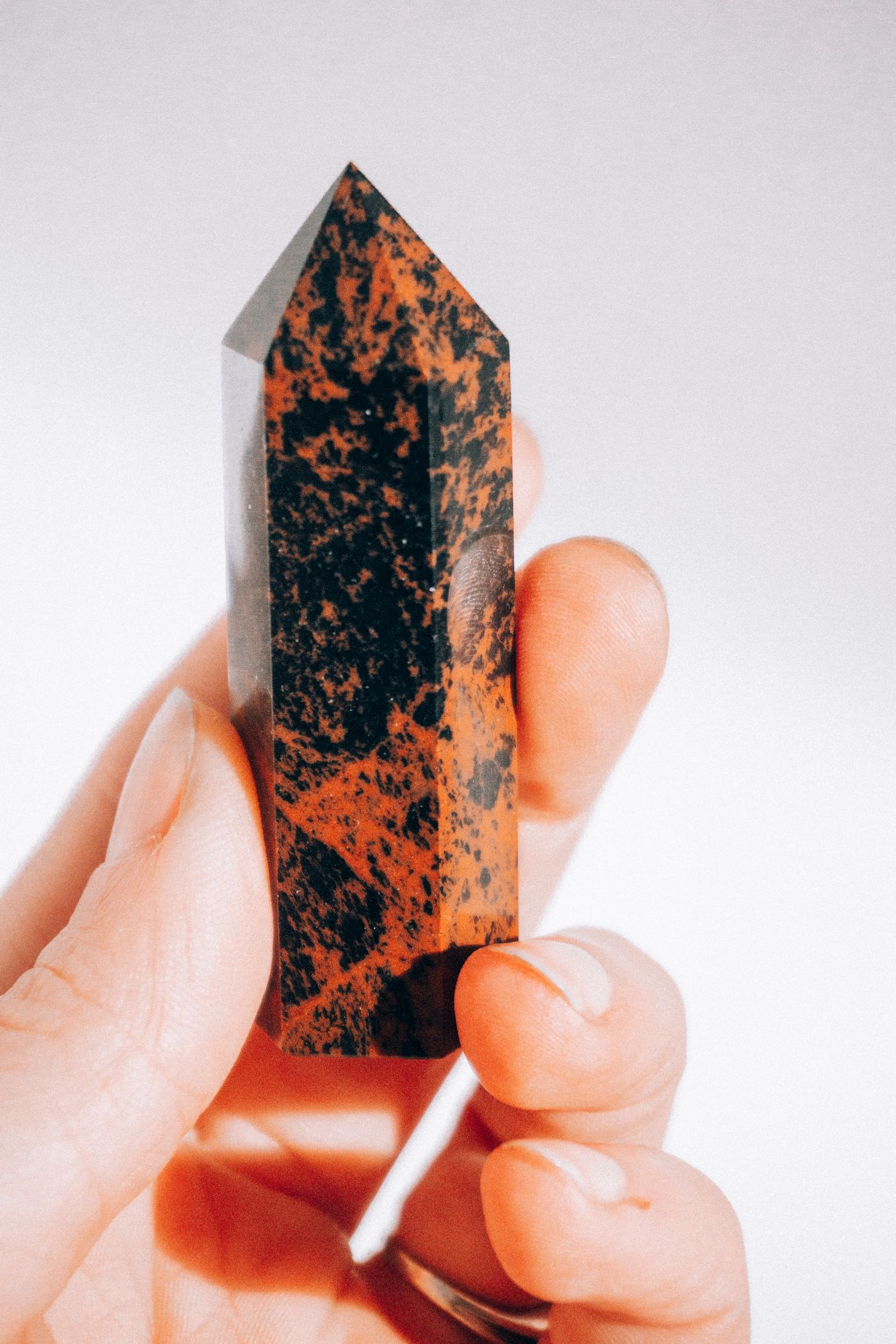
AT A GLANCE
Dark polished jewelry is difficult to judge from one image. Learn to read reflections, request useful angles, distinguish appearance from identification, and evaluate the information surrounding an obsidian listing. This guide offers a practical method for comparing online pieces while keeping claims about natural origin, treatment, provenance, condition, and craftsmanship separate from what a photograph actually shows.
A glossy surface records its surroundings
A photograph of dark polished jewelry often shows two things at once: the object and the room reflected in it. A bright rectangle may be a window, a pale stripe may be a lamp, and a dark central region may reflect the camera. These shapes can make a simple pendant appear complex or conceal features you want to inspect. Before interpreting a mark as part of the material, ask whether it changes or disappears in another view.
This is not a reason to distrust photographs altogether. It is a reason to use them for the questions they can answer. Images can help describe outline, scale, visible finish, arrangement, and some aspects of construction. They are less reliable for establishing material identity, hidden condition, or a documented history. A careful comparison treats photographs as one layer of information, supplemented by a written description, useful specifications, and answers from the seller.
Begin with the complete object
Start with a full view rather than the most dramatic close-up. Establish what is being offered: pendant, bracelet, earrings, ring, loose bead, or another object. Confirm which components are included. A chain, display cord, or matching piece in the photograph may be styling rather than part of the sale. The image should help you understand the complete purchase, but the written listing needs to resolve anything that remains ambiguous.
Notice whether the object is shown in more than one position. A pendant resting on a tabletop can look different when hanging upright. A bracelet wrapped around a display support may conceal the closure or a section of the strand. Earrings photographed separately may be difficult to compare as a pair. Request the views that correspond to the object you intend to wear. A full-object image often reveals proportion and balance more honestly than an isolated beautiful surface.
Use reflections to understand shape
Reflections can be useful even when they complicate surface inspection. A broad highlight may help show the curve of a cabochon, while a narrow one can reveal an edge or change in plane. Compare several angles and observe how the reflected shapes travel. A smooth continuous reflection may suggest an even contour, but it does not prove flawless polish or absence of internal features. Avoid turning a visual impression into a stronger conclusion than the image supports.
If a white glare covers the area you need to assess, ask for a view with softer or differently positioned light. The request should be specific: the edge near the bail, the reverse face, or the drilled opening. Asking for more photographs without explaining the question may simply produce more versions of the same attractive angle. A useful image request connects a visible uncertainty to a view that could reasonably clarify it.
A black image does not identify obsidian
USGS describes obsidian as volcanic glass formed under conditions that inhibit crystal growth. That geological identity cannot be established simply because a photographed object looks black and glossy. Several natural and manufactured materials can share a dark polished appearance. Color, shine, and shape are descriptive observations, not a complete identification procedure. A familiar retail silhouette does not change that limitation, even if it resembles many pieces you have previously seen labeled obsidian.
Ask the seller to state the material clearly in writing. If the purchase depends strongly on that identity, consider whether independent examination is appropriate. Do not rely on home scratch, heat, impact, or chemical tests on finished jewelry. Such tests can damage the object or its construction and still leave the question unresolved. A photograph can support a conversation about identification, but it should not be presented as an identification certificate in its own right.
Natural origin and geographic origin are separate
The claim that a material formed naturally is different from a claim that it came from a particular place. A listing may attach a regional story to an object because the region is associated with obsidian, but association alone does not document the source of the individual piece. Ask how the seller knows the origin and what records support it if that detail affects the price or your reason for buying.
A photograph of a polished pendant generally cannot establish its mine, volcanic deposit, or country of extraction. A seller may have reliable supplier records, limited supplier information, or no specific provenance. Each situation should be described accurately. If the origin is unknown, it is better for that uncertainty to remain visible than to be filled with a plausible story. You can still appreciate a design without pretending its complete geological and commercial journey is documented.
Do not confuse visual features with a full explanation
Some obsidian varieties show patterns or optical appearances that attract special retail names. A photograph may help you see the feature being described, but the name and its cause deserve a clear explanation when they are central to the sale. Ask whether the image shows the exact item, what lighting was used, and whether any treatment or surface modification is disclosed. Do not assume that every unusual color in a photograph belongs to the material rather than a reflection.
Equally, do not dismiss a feature simply because it is subtle in one image. Directional lighting, orientation, exposure, and screen settings can change what is visible. A short video may be useful if it shows the object slowly under steady light. The value of the video is descriptive: it demonstrates a range of appearances. It does not, by itself, prove identity, natural origin, absence of treatment, or rarity.
Surface condition requires more than one angle
A scratch can disappear in one view and become obvious in another. A chip near the perimeter may be hidden by a setting, a shadow, or the crop. Request clear views of exposed edges and areas around drilled holes. If an image is too compressed to distinguish a mark from a pixel artifact, ask for a closer photograph rather than enlarging it indefinitely. Enlarging a low-information image does not create new reliable detail.
Describe concerns neutrally when contacting the seller. Instead of declaring that a visible pale line proves a fracture, ask what the line is and request another angle. The seller may be able to explain or inspect it, while a qualified professional may be needed for a consequential condition question. This approach does not require unquestioning trust. It simply separates an observation from a diagnosis and makes the next step more likely to produce useful information.
The back and side are essential views
The front often receives the most careful lighting because it carries the design. The back can reveal how the piece is assembled, how it rests against clothing, and whether a surface is finished for comfortable wear. Side views show thickness, projection, and the relationship between material and setting. A pendant that appears broad and substantial from the front may be thin, hollow-backed, or framed in a way that the hero image does not make apparent.
Ask for images of the suspension point and closure too. A beautiful front does not establish the condition of a bail, jump ring, clasp, or cord. These small components determine whether the object can be worn securely and whether it can accept a different chain. If the listing uses a broad metal description, request the composition of the components that touch the skin. The visual impression of silver-colored metal is not the same as a precise statement of its composition.
Scale needs a physical reference
An isolated close-up can make a tiny pendant look monumental or a substantial bracelet look delicate. Read dimensions and compare them with a familiar object or a paper outline made at actual size. A ruler image can help if the ruler lies in the same plane as the measured feature. An on-body photograph offers another context, but it still reflects the model's proportions and the camera's perspective rather than guaranteeing the same appearance on you.
Ask whether the dimensions include the bail, clasp, or other fittings. For earrings, distinguish the stone size from the full hanging length and ask whether a listed weight is for one earring or the pair. For bracelets, clarify the difference between bead diameter and finished internal fit. These specifications answer practical questions that no amount of surface detail can resolve. A visually appealing image should lead you toward the measurements, not replace them.
Compare images on a fair basis
Two sellers may use very different photographic styles. One may show a brightly lit object against white; another may use deep shadows and a black background. The second image may feel more luxurious without providing more useful information. Try to compare similar views under ordinary light. Ask for a neutral full-object photograph if the listing relies entirely on dramatic close-ups. You are not asking the seller to abandon presentation; you are asking for enough context to make a practical decision.
Do not infer exact color or surface gloss from a screen alone. Monitor settings, phone processing, compression, and ambient light can all affect what you see. If a very specific appearance is essential, give more weight to inspection and return arrangements. A fair comparison acknowledges uncertainty rather than mentally correcting each photograph until it matches the version you hope to receive. The ability to describe what remains unknown is part of an informed purchase.
Exact-item photographs reduce one uncertainty
An exact-item photograph shows the individual piece offered, while a representative photograph illustrates a design or product type. Both can be legitimate if labeled clearly. The distinction matters when pattern, proportions, or matching are central to your choice. Ask directly whether the pictured item is the one supplied. If it is not, request the expected range of variation and, where practical, an image of the actual piece before shipment.
Representative imagery is especially important to clarify for bead strands and paired earrings. A repeated design may use components with visible differences, and the particular arrangement in the listing may not be reproduced. A seller should not have to promise impossible uniformity in a varied material, but the buyer should understand the basis of the offer. Clear communication turns variation into a known design characteristic rather than an unwelcome surprise.
Documentation should answer a defined question
If a report, appraisal, or certificate is shown, read it in relation to the claim being made. An identification document may address material identity without providing a value. An appraisal may serve a different purpose and may rely on descriptions that need their own verification. A generic certificate included with many items is not necessarily equivalent to an independent examination of the individual piece. Ask who issued it, what was examined, and how it connects to the object offered.
Avoid treating a photographed document as self-verifying. Use an appropriate issuer verification route when available, and be cautious about cropped images that omit relevant information. At the same time, keep expectations proportionate. A modest decorative accessory may not justify extensive laboratory work. The important principle is that the strength of a claim should match the evidence, especially when the price depends on rarity, origin, an unusual variety, or a particular attribution.
Meaning should not substitute for material information
Obsidian is often marketed with language about protection, grounding, or absorbing negative energy. Those statements should not replace practical information about the item. A personal symbolic association can be meaningful, but it is not evidence of a physical benefit or a guarantee about the wearer's life. Ask the same questions about dimensions, construction, care, and identity whether or not a listing includes spiritual language.
You may choose the jewelry because its dark surface feels visually calm or because it recalls a place, a person, or a private intention. Describe that as your own response. There is no need to claim that the object treats a condition or prevents harm. A purchase becomes easier to assess when symbolic meaning and material representation remain distinct. The design can carry personal significance while still being evaluated as a physical object with ordinary limits.
Build a small evidence file
Save the listing, the seller's answers, the relevant images, and the receipt. Note the dimensions, material representation, disclosed uncertainty, and return terms. When the piece arrives, compare it gently under ordinary lighting and record its condition before extended wear. If something differs, describe the discrepancy specifically. A mismatch in scale, an undisclosed construction detail, or a different item from the one pictured can be discussed more productively with a clear record.
Do not convert disappointment into a claim you cannot substantiate. An appearance mismatch does not automatically prove misidentification, and a surface mark in a photograph does not automatically prove hidden structural damage. Explain what you observe and what information would resolve the issue. If specialist assessment is needed, that can become the next step. Accurate language protects the value of your own evidence and keeps the conversation focused on the actual problem.
Use photographs to become more curious
The best outcome of looking carefully is not a feeling that you can authenticate every dark stone online. It is a clearer understanding of what you like, what the image shows, and what still needs explanation. A useful photograph invites questions about proportion, finish, and construction. A useful seller provides information that goes beyond the photograph. Together, those layers can support a thoughtful choice without pretending that remote shopping removes every uncertainty.
Obsidian jewelry can be appreciated for a strong silhouette, a polished dark surface, and a well-resolved setting. None of those pleasures requires exaggerated certainty. Look at the whole object, request the missing views, read the specifications, and keep claims in their proper categories. That method gives the image a valuable role while leaving identity, origin, condition, and craftsmanship to the evidence appropriate for each question.
References & further reading
References provide background and further reading. Linked organizations do not endorse or certify this publication.
For general education. The identity, treatments, construction, and condition of an individual object may require professional examination. Our editorial approach.
Back to the beginning