AT A GLANCE
A few millimeters can change how a strand looks, fits, and moves. Learn to read bead diameter, bracelet circumference, necklace length, hole size, and total weight without treating them as interchangeable specifications. This guide uses practical comparisons to connect online measurements with the physical experience of natural-stone jewelry and to identify the questions a listing still needs to answer.
Numbers should describe an object you can imagine
An online listing may provide several measurements and still leave the jewelry difficult to picture. A bead diameter tells you something different from a bracelet length, while a weight tells you neither of those things directly. The challenge is not simply to collect more numbers. It is to understand which part of the object each number describes and how that part affects appearance, fit, movement, and maintenance. Clear measurements connect a photograph to a wearable object.
Start by separating the specifications into groups. Bead size describes individual components. Finished dimensions describe the assembled piece. Internal fit describes the space available around the body. Weight describes how much the object weighs, ideally with a clear statement of which components are included. Construction measurements describe holes, clasps, bails, and connections. When a listing gives one number without explaining its role, ask for clarification rather than allowing it to answer several unrelated questions in your mind.
Bead diameter is not bracelet size
For a round bead, diameter is the distance across the bead. A strand described with one bead diameter may contain nominally similar beads, not an exact measurement of every component. Ask whether a stated size is approximate and whether spacers or focal beads differ. A photograph with a ruler can help, but perspective and the position of the ruler matter. A macro image without a scale reference can make a modest bead appear much larger than it will be on the wrist.
Bracelet size refers to the assembled object or its intended fit, depending on the seller's convention. A bracelet made with larger beads may have less internal room than another strand with the same outside measurement. This is why simply multiplying bead count by diameter is not a dependable substitute for the maker's finished-fit information. Ask what the listed bracelet number represents: straightened strand length, outside circumference, internal circumference, or a recommended wrist size.
Measure the intended wearing position
Use a flexible tape held comfortably against the wrist, without tightening it enough to compress the skin. Measure where you expect the bracelet to sit, and repeat the process. If a strip of paper is used instead, mark it carefully and measure the marked length flat. Avoid a stretchy cord that changes length when handled. Record the wrist measurement separately from the amount of movement or looseness you prefer, because those are different pieces of information.
Do not automatically add a fixed amount and assume the result will work for every construction. Large beads, flat links, cuffs, and elastic strands can fit differently. Tell the seller your wrist measurement and the fit you want, then ask which finished option they recommend. If you own a comfortable reference bracelet, describe its construction and internal space. A measurement borrowed from a different format is useful context, but it should not be treated as an exact universal conversion.
Inside and outside measurements tell different stories
A thick bracelet occupies space both around and away from the wrist. Its outside circumference follows the outer surfaces of the beads, while the internal circumference describes the opening available to the wearer. The gap between these measurements becomes more significant as components become larger or thicker. A seller may use either figure informally, so a familiar-looking size number can conceal a practical ambiguity. Ask for the method, especially when ordering a fitted piece that cannot be adjusted easily.
For a rigid bangle, the internal diameter is a different specification again. The hand must pass through the opening, which means wrist circumference alone is not enough. For an open cuff, the gap and the maker's adjustment guidance also matter. Avoid bending a cuff repeatedly to improvise a fit unless it is designed for that use. Natural-stone bead bracelets do not share every sizing principle with rigid metal jewelry, even when the same retail size labels appear beside them.
Bead shape changes how dimensions are reported
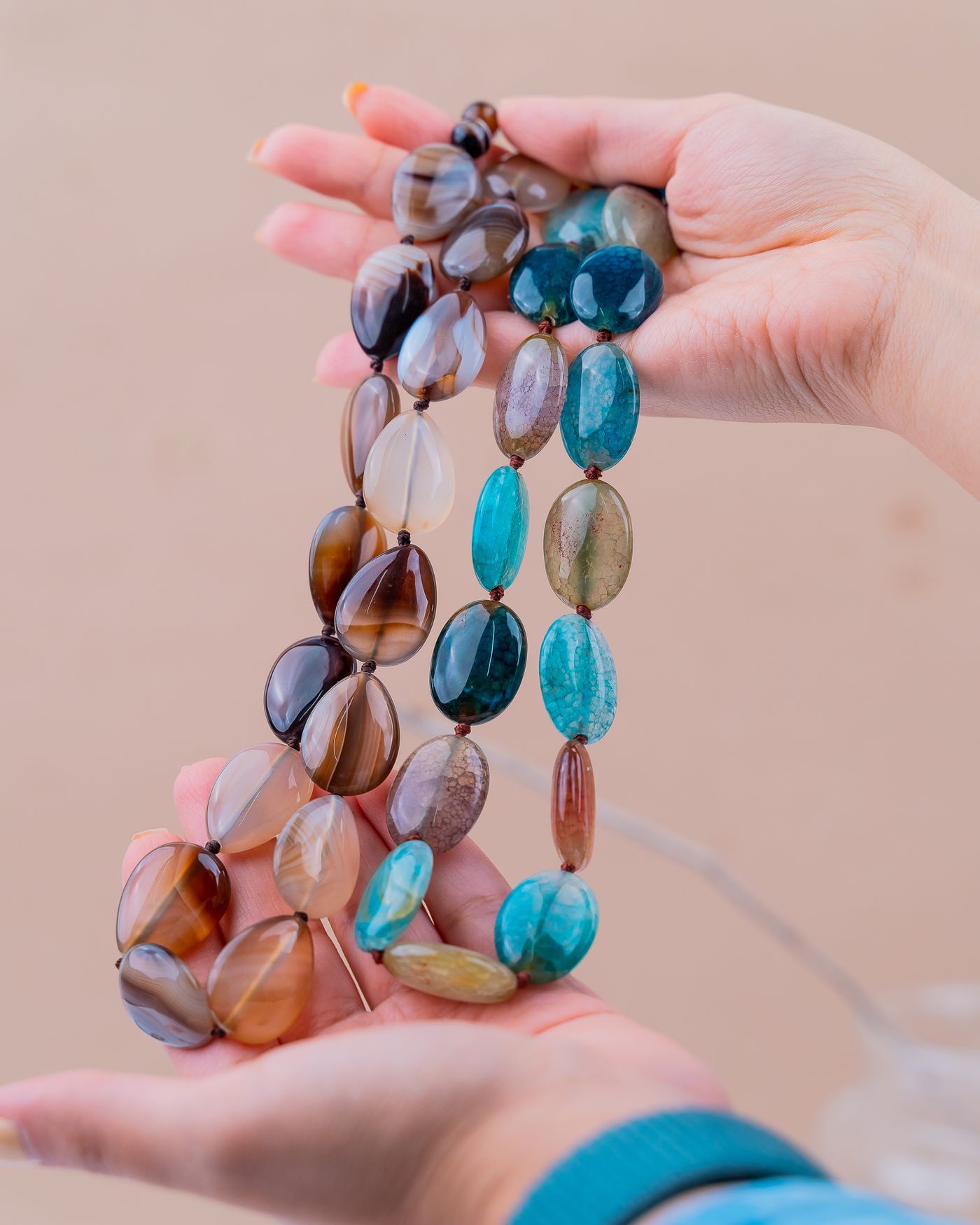
A round bead can often be summarized by one diameter, but a rondelle, tube, oval, or irregular bead needs more information. A flattened bead may be listed by width and thickness. A long bead may need length as well as width. An irregular chip strand may be described by a range. Read the order of dimensions carefully and ask which direction follows the stringing. Two components with similar width can occupy very different lengths along a strand.
Shape also affects contact with the body. A flat-backed component may sit quietly, while a rounded one may roll. An elongated bead can create a different rhythm around a wrist than several small spheres. These are design characteristics rather than reasons to prefer one format universally. If comfort matters, ask for a side view and an on-body photograph. Measurements tell you the scale, but the way the components articulate and meet one another tells you how that scale becomes movement.
A necklace length needs a reference point
Ask whether a necklace length includes the clasp, extender, pendant, or only the beaded strand. The answer changes how the piece sits. A pendant may hang below the stated necklace length, and a clasp can contribute more length than expected. For an adjustable design, establish the shortest and longest finished options. A listing that gives a range without explaining the mechanism leaves you guessing whether the adjustment is continuous, limited to several rings, or dependent on a separate extender.
Use a nonstretch cord or an existing necklace to imagine the position on your own body, but remember that bead thickness can change the drape. A strand of substantial beads does not behave exactly like a fine chain of the same length. Neckline, posture, and body proportions also affect the wearing position. A model photograph is a useful scale reference, not a guarantee that the necklace will land at the same point on every wearer.
Pendant dimensions should distinguish stone and setting
A pendant's listed measurements may describe the stone alone, the complete face, or the overall length including the bail. These can be quite different. Ask for width, height, and thickness of the complete pendant, with the bail included or excluded explicitly. If a chain is pictured, confirm whether it is part of the purchase. A beautifully proportioned pendant on a carefully chosen chain may look different when placed on a chain you already own.
The bail's internal opening is especially relevant when changing chains. The chain's width does not necessarily describe the widest component that must pass through; a clasp or end fitting can be larger. Compare the bail opening with that component, not just the chain body. If the pendant uses a fixed cord or a connector that cannot be opened casually, ask how replacement works. A small dimension hidden above the main design can determine whether the piece is as versatile as you expect.
Weight is practical information, not a quality score
A heavier object may feel substantial, but weight alone does not establish authenticity, durability, or fine workmanship. Different materials and constructions produce different weights for the same apparent size. Ask whether a listed weight covers the full piece, the stone only, or a pair of earrings together. For earrings, the difference between total pair weight and weight per earring is significant. For a pendant, the chain may or may not be included.
Consider how long you expect to wear the piece. A weight you enjoy briefly may become distracting during a full day. If you have a comfortable reference object, weigh it if practical and compare formats cautiously. A heavy bracelet distributes weight differently from heavy earrings, and a pendant depends partly on its chain. The specification is most useful when connected to your own experience rather than used to declare that more material must mean a better purchase.
Hole size belongs to construction
The hole through a bead affects what stringing can pass through it and how repairs may be approached. It does not need to appear prominently in every finished-jewelry listing, but it becomes important for custom work or later restringing. A cord that looks similar in color may be too thick, too thin, or otherwise unsuitable. Ask the maker what material and dimensions were used if future maintenance matters to you.
Also consider the hole's finish and the area around its openings. A rough edge can affect stringing, while an unusually thin remaining section can raise questions about suitability. A remote image cannot establish every aspect of condition, so use photographs to guide questions rather than perform an imagined engineering inspection. Do not enlarge a hole at home to accommodate a preferred cord. That is specialized work that can change or damage the bead and may create dust or fragments.
Closures change usable length
A clasp, extender, knot, or sliding mechanism occupies space and affects the fit. In some designs, the stated length includes all of it; in others, it does not. A bracelet with a bulky clasp may feel different when the closure rests under the wrist. An extender can provide adjustment but may also leave a loose tail. Ask how the piece is intended to sit and whether the adjustment remains comfortable at both ends of the range.
Operate a closure when trying jewelry in person, using the hand you will actually use at home. A very small clasp can be visually discreet but inconvenient. A magnetic closure, toggle, hook, or sliding knot introduces its own practical considerations and should be evaluated according to the design rather than assumed equivalent to another format. Measurements should support that evaluation: opening size, component dimensions, and adjustment range are meaningful only when you understand how the fastening works.
Translate measurements with a simple physical mock-up
For a pendant or focal bead, draw the listed outline on paper at actual size and cut it out. Hold it at the intended position without treating the paper as a weight simulation. This can reveal whether the visual footprint is larger or smaller than the photograph suggested. For earrings, compare the outline beside an existing pair and include the full hanging length. A small stone plus a long fitting may occupy more space than the stone measurement alone implies.
For a bracelet, compare beads of a known size if you have them, or use a ruler to visualize the diameter beside your wrist. Do not build a false fit prediction from an improvised model with different components. The mock-up's purpose is to clarify scale, not replace the seller's sizing advice. When the visual size seems right but the fit remains unclear, ask for the missing internal measurement rather than forcing the information you have to answer a question it cannot resolve.
Read tolerances and variation fairly
Natural-material jewelry and hand assembly can involve small differences. A listing should communicate whether measurements are approximate and what variation is expected. That does not mean every discrepancy is unimportant. A minor bead-size variation may be visually acceptable, while a small change in internal circumference can matter greatly to a close fit. Decide which dimensions are critical before ordering, and ask the seller to confirm those for the actual piece when possible.
Be precise when discussing a mismatch. State which measurement you took, how you took it, and how it differs from the description. Avoid comparing an outside measurement with a listed internal one or a complete pendant height with a stone-only figure. Clear definitions make it easier to determine whether the issue is a misunderstanding, a measurement convention, or an actual discrepancy. Photographs with a ruler can support the conversation if they are arranged to show the relevant dimension clearly.
Keep a useful specification record
Save the listing and the seller's clarification with the receipt. Include bead dimensions, finished fit, metal components, stringing, treatment disclosures, and care instructions where available. If the piece is resized, update the record so the original specification is not mistaken for the current one. A photograph of the complete arrangement can help a repairer if a strand breaks or a component is lost. These ordinary records make future decisions easier without pretending to be a formal appraisal.
If buying a gift, pass along the information the recipient will need. A bracelet's nominal size is less useful than a clear explanation of its fit and resizing options. Earring weight, metal composition, and fastening style may matter more than the marketing name of the collection. Good specifications are a form of consideration: they allow the wearer to understand, maintain, and adapt the jewelry instead of guessing what the numbers on an old order confirmation meant.
Choose clarity over a crowded specification list
A useful jewelry listing does not need endless measurements. It needs the right measurements, defined accurately and connected to the object. If the information is incomplete, a concise question can resolve more than another page of adjectives. Ask what the number describes, whether it includes the relevant components, and how it relates to the way you intend to wear the piece. Then compare candidates on the same basis.
Natural-stone jewelry is enjoyed through color, texture, pattern, and personal meaning, but those qualities arrive in a physical format. A few millimeters can change comfort, a bail opening can determine chain compatibility, and a clear weight can prevent an unsuitable gift. Understanding the specifications leaves more room for enjoyment because the practical surprises are reduced. The goal is not to make the purchase mechanical; it is to give your visual preference a reliable physical context.
References & further reading
References provide background and further reading. Linked organizations do not endorse or certify this publication.
For general education. The identity, treatments, construction, and condition of an individual object may require professional examination. Our editorial approach.
Back to the beginning